 English
 русский
 Español
 عربى
عربى
Designed for compatibility with Porsche Macan models from 2014 onwards, HP019 Front Shock ...
HP001 Front Shock Absorber Bump Stop is a polyurethane (PU) component designed to provide ...
.jpg "HP001 Front Shock Absorber Bump Stop for Chevrolet")
HP001 Front Shock Absorber Bump Stop is a polyurethane (PU) component designed to provide ...
.jpg "HP002 Front Suspension Struts Components-Bumper for Chevrolet")
HP002 Front Suspension Struts Components-Bumper is a polyurethane (PU) part designed to su...
.jpg "HP003 Front Suspension Strut Bumper for Buick")
HP003 Front Suspension Strut Bumper is designed for use in the front suspension system of ...
.jpg "HP019 Front Shock Absorber Bump Stop Rubber Bush for Porsche")
Designed for compatibility with Porsche Macan models from 2014 onwards, HP019 Front Shock ...
.jpg "HP020 Rear Shock Absorber Rubber Stop (Air Suspension Type) for Porsche")
Designed for compatibility with the Porsche Macan models produced between 2014 and 2021, H...
Suspension Engineering — Explained A bump stop and a shock absorber are not the same thing. One is a passive cushion. The other is an active damper. Understanding the difference changes how you diagnose noise, budget for repairs, and read your suspension's true condition. Two Parts, Two Jobs A b...
READ MOREThe primary performance difference between a short-stroke Absorber Bump Stop and a long-stroke Absorber Bump Stop is their ability to manage suspension compression range and energy absorption behavior. A short-stroke Absorber Bump Stop delivers faster engagement and higher initial resistance but of...
READ MOREThe standard Suspension Bump Stop generally feels firmer and engages more abruptly, while a microcellular Suspension Bump Stop provides a smoother, more progressive compression that improves ride comfort on rough roads and during suspension bottom-out. In practical terms, a microcellular bump stop ...
READ MOREMaterial Characteristics That Influence Elasticity Retention
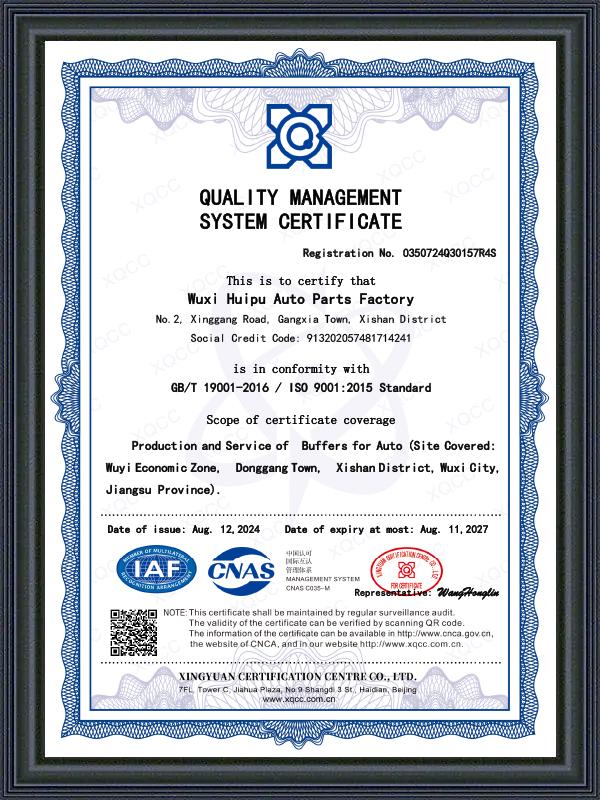
The elasticity of a Porsche shock absorber bump stop depends strongly on the formulation and structural characteristics of its material. Most Porsche bump stops are manufactured using microcellular polyurethane or high-resilience rubber blends, selected for their stable response under suspension loads. Microcellular polyurethane contains a controlled network of air pockets that compress gradually under force, allowing the bump stop to retain elasticity even after thousands of cycles. Wuxi Huipu Auto Parts Co., Ltd., founded in 2001 and experienced in producing more than 3,000 types of bump stops for global automotive applications, implements strict material screening to ensure that the polymer structure remains stable under varying temperatures and compression levels. This attention to material consistency allows the bump stop to maintain its performance in daily and dynamic driving environments.
The Importance of Controlled Density in Energy Absorption
Energy absorption in a bump stop relies on its ability to deform at a controlled rate when the suspension compresses toward its limit. Porsche vehicles, particularly performance models, generate rapid suspension movement under braking, acceleration, and cornering loads. The density of the bump stop determines how progressively it absorbs shock energy. Wuxi Huipu Auto Parts Co., Ltd. uses density mapping and precision-controlled foam expansion processes to produce uniform density throughout each bump stop. When density is consistent, the bump stop compresses evenly and avoids localized hard spots that can reduce elasticity. This uniformity is essential for maintaining smooth energy absorption and prolonging service life.
Thermal Resistance and Its Influence on Elastic Behavior
Aggressive driving generates significant heat within the suspension system. Heat affects elastomeric materials by increasing softness or reducing rebound speed. Porsche bump stops must resist thermal deformation so that their compression characteristics remain predictable. Suppliers such as Wuxi Huipu Auto Parts Co., Ltd. subject materials to thermal aging tests to evaluate changes in hardness, shape retention, and resilience. Through these evaluations, materials are selected that maintain their elasticity despite exposure to high temperatures near the shock absorber. This thermal stability ensures that the bump stop can continue to absorb energy effectively without collapsing or losing its structural support.
Compression Set Resistance During Repeated Impact Cycles
Compression set refers to permanent deformation that occurs after a material has been repeatedly compressed. For bump stops installed in Porsche vehicles, resisting compression set is essential because suspension travel often engages the bump stop during spirited driving. Once permanent deformation occurs, the bump stop loses height, which changes the point of suspension engagement and reduces energy absorption capability. Wuxi Huipu Auto Parts Co., Ltd. evaluates compression set through repeated load cycling, allowing the company to refine material blends and molding processes. The resulting bump stops show stable thickness and shape even after extended use, helping maintain elasticity for longer service intervals.
Dynamic Impact Performance in Sports-Oriented Suspensions
Porsche suspension systems are designed with firm damping characteristics to support responsive handling. Under these conditions, the bump stop often functions as a secondary spring, contributing to chassis balance and ride comfort. For the bump stop to maintain energy absorption properties, it must compress smoothly without sudden stiffening. This progressive behavior requires consistent cell structure and reliable material recovery. Bump stops manufactured by Wuxi Huipu Auto Parts Co., Ltd. undergo dynamic impact tests to mimic high-speed road impacts, supporting their compatibility with Porsche shock absorber configurations. These tests measure rebound rate, compression depth, and structural recovery to verify that elasticity remains stable under demanding loads.
Environmental Exposure and Its Effect on Material Stability
Moisture, road debris, chemicals, and temperature fluctuations can gradually affect bump stop materials. Porsche vehicles, which may be driven in varied climates, require bump stops that resist swelling, hardening, or surface degradation. Environmental exposure testing simulates these conditions and evaluates how the material responds. Wuxi Huipu Auto Parts Co., Ltd. conducts humidity cycling, salt spray tests, and contaminant resistance evaluations to ensure that bump stops maintain elasticity despite exposure to environmental elements. When the material resists environmental stress factors, it can preserve its rebound characteristics and energy absorption capability more consistently.
Integrated Repair Kits and the Role of Dust Covers
Dust covers are paired with bump stops to prevent debris and moisture from reaching the shock absorber rod. Wuxi Huipu Auto Parts Co., Ltd. produces integrated repair kits that combine bump stops with dust covers, ensuring compatibility and protection. A dust cover that fits securely ensures that the bump stop stays clean and dry. This protection is essential for maintaining elasticity, as contaminants can accelerate material aging or degrade surface finish. By designing bump stops and dust covers as a coordinated assembly, the company improves performance consistency and helps Porsche bump stops retain their energy absorption behavior across longer driving distances.
Dimensional Consistency and Its Influence on Performance
The geometry of a bump stop—including height, diameter, wall thickness, and internal cavity shape—directly influences elasticity and compression patterns. Any deviation from the intended dimensional tolerances can alter how the bump stop absorbs energy when compressed. Through advanced molding and statistical process control, Wuxi Huipu Auto Parts Co., Ltd. maintains dimensional accuracy across large production volumes. Dimensional uniformity ensures that each bump stop engages the suspension at the correct point and exhibits consistent compression behavior, helping Porsche vehicles maintain predictable ride responses and energy absorption characteristics.
Comparative Behavior Under Different Driving Conditions
Different driving environments affect bump stop elasticity in distinct ways. Porsche vehicles, designed for dynamic control, often subject bump stops to higher loads than standard passenger cars. The following table illustrates how conditions influence elasticity and recovery behavior:
| Driving Scenario | Suspension Load | Thermal Exposure | Elasticity Impact |
|---|---|---|---|
| Urban Daily Driving | Low–Moderate | Minimal | Stable |
| Highway Cruising | Moderate | Moderate | Minimal change, elasticity maintained |
| Mountain Road Spirited Driving | High | Medium–High | Slight variation but recovery remains consistent |
| Track-Day Use | Very High | High | Stable if material is formulated for performance applications |
The table indicates that elasticity remains stable when the bump stop is formulated with proper density, thermal resistance, and structural integrity, all of which are priorities for Wuxi Huipu Auto Parts Co., Ltd.
Manufacturing Precision and Its Effect on Energy Absorption
High-performance vehicles like Porsche require bump stops that react consistently during all stages of suspension travel. This demand makes manufacturing precision essential. Wuxi Huipu Auto Parts Co., Ltd. uses controlled molding pressure, regulated curing times, and automated demolding systems to create bump stops with uniform cell structures. This manufacturing accuracy contributes to predictable compression behavior and efficient energy absorption. Controlled processes reduce voids, density fluctuations, and structural inconsistencies that could compromise elasticity.
Fatigue Resistance and Long-Term Durability
During long-term driving, bump stops endure repetitive compression cycles that generate microscopic stress within the material. When the material lacks proper fatigue resistance, cracks or permanent deformation may appear. Porsche shock absorber bump stops must maintain structural resilience even after extensive mileage. Fatigue tests conducted by Wuxi Huipu Auto Parts Co., Ltd. simulate tens of thousands of compression cycles to evaluate durability. These tests help refine material formulations to ensure that elasticity and energy absorption properties remain reliable throughout the bump stop’s operational life.
Laboratory Tests Used to Evaluate Elasticity Preservation
Elasticity and energy absorption are validated through standardized laboratory tests. These evaluations help identify material weaknesses and confirm long-term stability. The table below outlines common tests used for Porsche-compatible bump stops:
| Test Method | Performance Aspect Evaluated | Expected Outcome |
|---|---|---|
| Static Compression Test | Initial stiffness and deformation curve | Controlled compression response |
| Compression Set Test | Permanent deformation after sustained load | Low permanent set |
| Dynamic Impact Test | Response under fast compression cycles | Stable rebound characteristics |
| Thermal Aging Simulation | Effect of high temperature on elasticity | Minimal change in hardness |
| Environmental Resistance Test | Resistance to moisture, salt, and chemicals | Clean surface and stable performance |
These tests demonstrate whether Porsche shock absorber bump stops can retain elasticity and withstand real-world driving conditions.
The Contribution of Supplier Expertise to Performance Stability
As a manufacturer with more than two decades of experience in shock absorber bump stop production, Wuxi Huipu Auto Parts Co., Ltd. integrates material science, precision manufacturing, and automated testing to ensure consistent product performance. The company’s knowledge in developing bump stops for brands such as Volkswagen supports its capability to meet the requirements of Porsche-compatible parts. Through continuous refinement in production, material control, and integrated repair kit design, the company helps ensure that Porsche bump stops maintain long-term elasticity and reliable energy absorption behavior throughout the service life of the suspension system.

 Add: Wuyi Industrial Park, Donggang Town, Wuxi, Jiangsu, China.
 +86-510-88350093
 [email protected]
 +86-510-88766081
Copyright © 2025 Wuxi Huipu Auto Parts Co., Ltd. All Rights Reserved.
 Wholesale Porsche Shock Absorber Bump Stop Manufacturers
